

Level 2: Experienced Investor
A Research Briefing by The Owl Engineer, Chief Optimizer, and Tiger Quant, Chief Signal Architect
The market whispers its plans long before it shouts the news. In the cannabis sector, after a catastrophic decline that purged weak hands and erased 95% of the sector's market cap, the whisper of institutional accumulation is becoming a roar.
First-level thinking sees a six-year bear market and dismisses the sector as a failed speculative bet. Second-level thinking asks the more incisive question: What is priced in?
The psychological capitulation of retail investors now stands in stark contrast to the methodical, data-supported accumulation by "smart money". This divergence signals a critical inflection point. Our analysis indicates a generational bottom is forming, underpinned by high-probability federal catalysts poised to fundamentally re-rate the entire industry within 12 to 24 months.
This is no longer a game of hope; it's a game of probabilities. And the odds are tilting dramatically in favor of the patient investor.
The Anatomy of a Generational Bottom
The period from early 2021 to mid-2025 will be remembered as one of historic capital destruction for the cannabis sector. A staggering 95% of the total market capitalization evaporated, falling from over $200 billion to just $9.4 billion. The sector's primary ETFs were decimated, with the AdvisorShares Pure US Cannabis ETF (MSOS) plunging 86% and the Amplify Alternative Harvest ETF (MJ) experiencing a drawdown of over 92%. The average cannabis stock now trades 87% below its all-time high.
This collapse triggered a textbook sentiment cycle, shifting from irrational exuberance to profound despair. The current environment is one of "extreme negative" retail sentiment. This widespread investor fatigue and capitulation is a classic hallmark of a durable market bottom.
The result is a historic valuation reset. During the 2021 peak, leading companies traded at price-to-sales (P/S) multiples exceeding 12x. Today, those same leaders trade at multiples of 2x or less. This compression has occurred even as U.S. legal cannabis sales are projected to hit $45 billion in 2025, creating a fundamental disconnect between operational growth and market valuation.
| Metric | Peak (Feb 2021) | Current (Aug 2025) | Change (Δ) |
| Total Sector Market Cap | >$200 Billion | ~$9.4 Billion | ~-95% |
| Global Cannabis Stock Index | 92.48 | 5.61 | -93.9% |
| Average Price vs. ATH | -- | -87% | -- |
| Average P/S Multiple | >12x | ≤2x | >-83% |
| Retail Sentiment | Euphoric | Extreme Negative | Contrarian |
The Twin Engines of Re-Rating: Federal Catalysts
The deep-value proposition is compelling, but it is the high probability of two transformative federal catalysts that provides a clear timeline for a sector-wide re-rating.
1. DEA Rescheduling: The Profitability Game-Changer
The most impactful catalyst is the administrative rescheduling of cannabis to Schedule III. Following a formal recommendation from the HHS, the DEA's final decision is anticipated within 6 to 12 months, with a 70% probability of a favorable outcome. This single move would immediately neutralize the punitive IRS Tax Code 280E, which results in effective tax rates exceeding 70%, transforming the financial profile of the entire industry overnight.
2. The SAFER Banking Act: Unlocking Capital Markets
The second engine is the bipartisan SAFER Banking Act, which would grant the cannabis industry access to the federal banking system. With strong support, its passage within 12 to 18 months is assigned an 80% probability. This would end the dangerous reliance on cash, unlock traditional loans, and, most critically, serve as a prerequisite for major institutional investors and uplisting to the NASDAQ and NYSE.
The Duo-Lens Dissection: Following the Smart Money
In markets defined by uncertainty, the actions of sophisticated investors provide the clearest signal. Our Duo-Lens system confirms that while retail capitulates, smart money accumulates.
Timeless Wisdom (The Foundation)
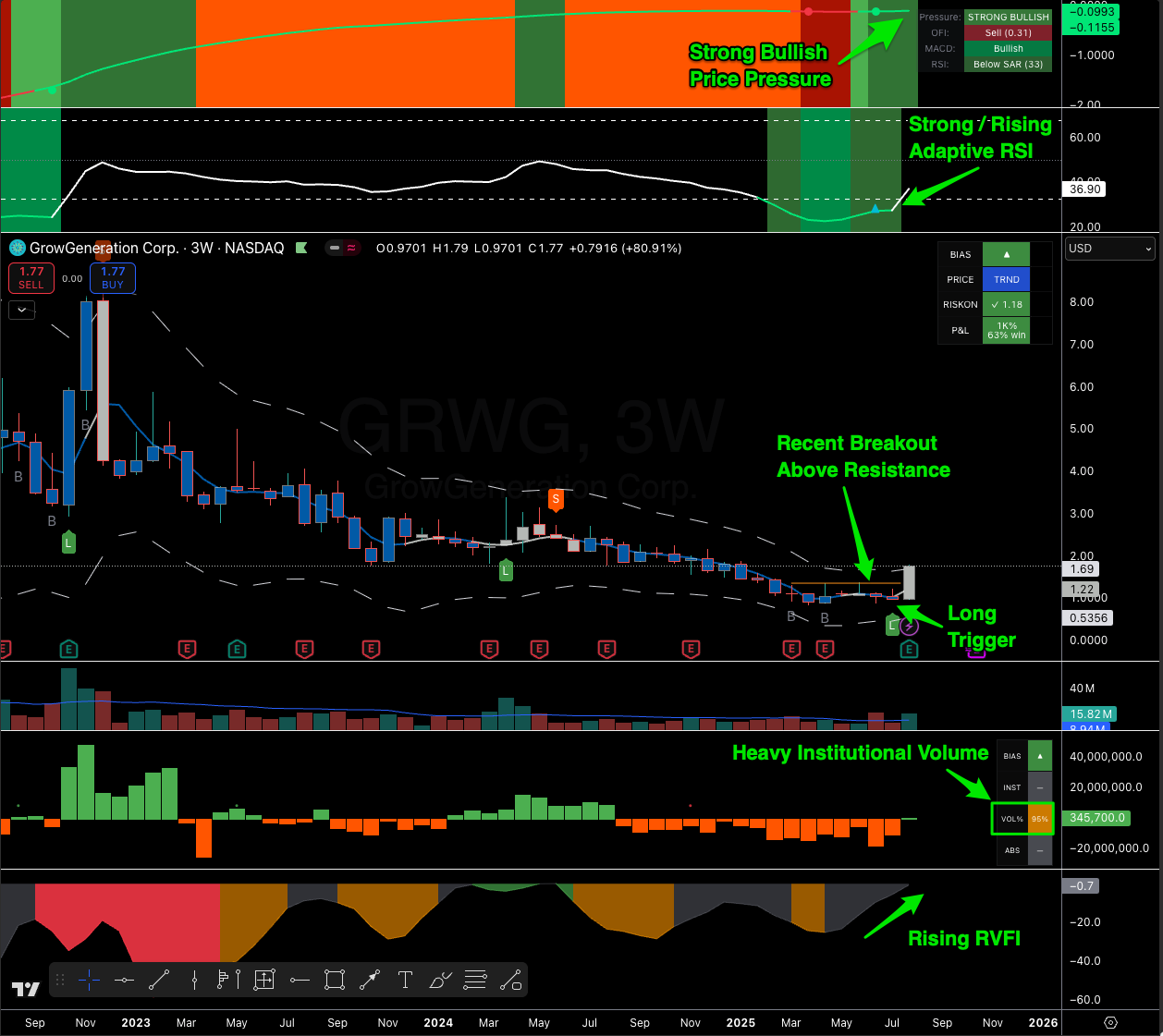
The 3W chart for Grow Generation Corp. (GRWG) reveals a textbook accumulation base with declining volatility and volume. This foundation has been meticulously built over a 31-month period between the beginning of 2023 to July 2025. The public has sold, and the groundwork for the next "Rise/Markup" phase is in place.
Modern Quant (The Confirmation)
Our proprietary indicators confirm what the chart structure suggests. The system is detecting a rising RVFI and both a strong, rising Adaptive RSI with Bullish Price Pressure. Furthermore, the Volume Pressure indicator is highlighting heavy institutional volume (95th percentile), while simultaneously flipping positive.
This technical setup has earned a "risk-on" score of 1.18 from our system, signaling a high-conviction opportunity with a strong Positive Bias.
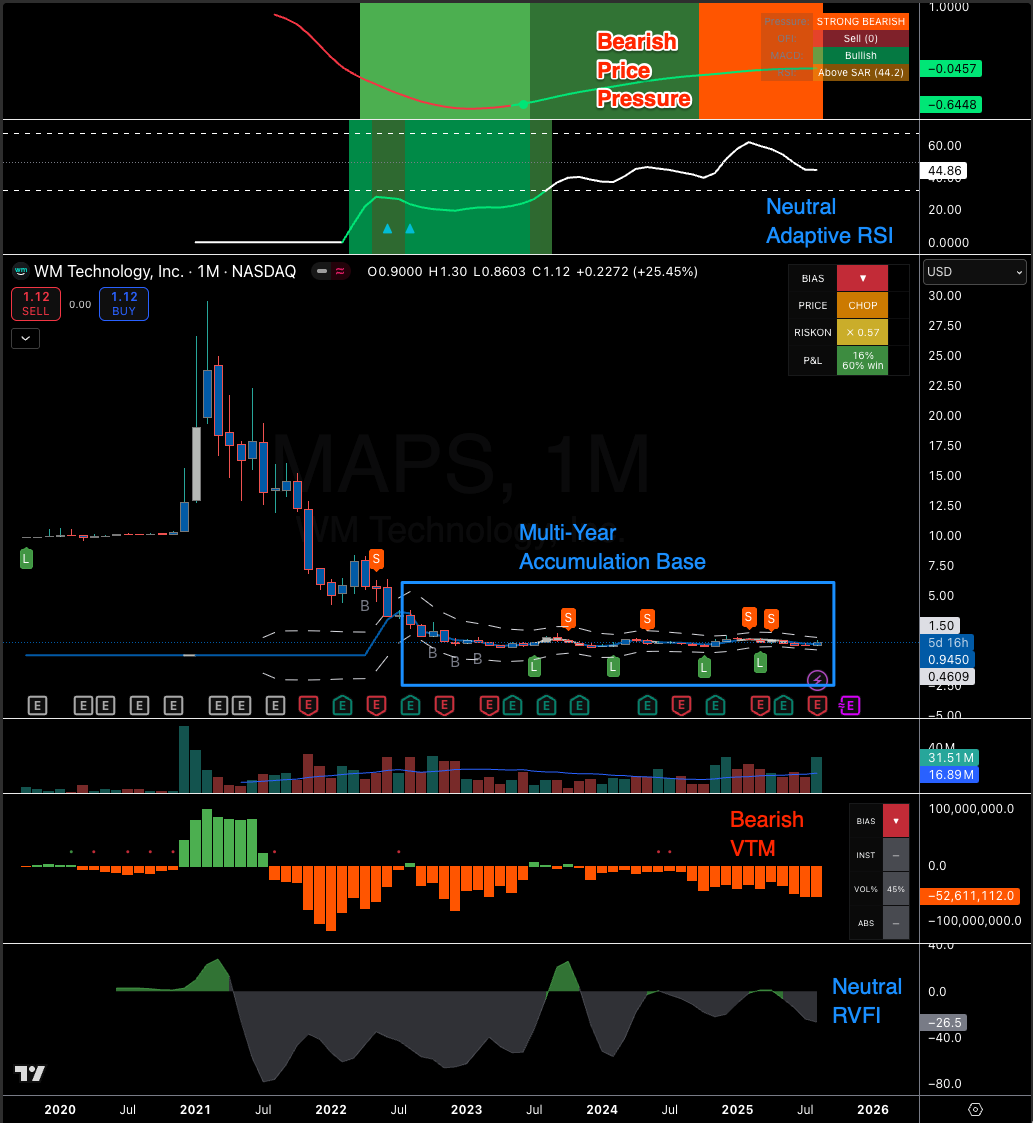
System analysis of WM Technology (MAPS) reveals a fundamentally robust asset operating under a condition of extreme market dislocation. The company functions as a near-monopoly in its niche with a highly defensible, asset-light SaaS model that generates 95%+ gross margins and has produced eight consecutive quarters of positive cash flow growth. Valuation is exceptionally compelling, with an EV/EBITDA multiple of 3.0x—a dramatic discount to its peers and historical averages. Further validation is provided by a 47.9% institutional ownership base that includes top-tier asset managers and a withdrawn $1.70 take-private offer that establishes a clear valuation floor well above the current price. Combined founder ownership of 21.6% signals strong insider alignment and conviction.
However, a powerful engine is useless without optimal operating conditions, and our current system telemetry from the monthly chart mandates a more disciplined approach. While the asset has formed a multi-year accumulation base since mid-2022, a prerequisite for any major markup phase, the trigger conditions have not yet been met. Our RVFI and Adaptive RSI indicators remain neutral, indicating a lack of volume-confirmed momentum. More critically, both our Price Pressure and Volume Pressure indicators are still bearish, signaling that the institutional engine has not yet fully engaged. This data mandates a patient, systematic approach. The correct strategy is to begin slow accumulation within this basing structure, preserving significant capital to deploy aggressively only when our quantitative indicators provide the definitive green light for a new markup cycle.
The Contrarian's Playbook: Strategy & Conviction Buys
Our stock selection methodology is simple: we follow the smart money. Before detailing our high-conviction picks, it's crucial to understand the different ways to gain exposure to the sector's recovery.
Choosing Your Vehicle
From a systems perspective, the cannabis sector offers several distinct components for investment:
- Broad-Market ETFs: For diversified exposure without single-company risk, vehicles like the Amplify Seymour Cannabis ETF (CNBS) provides a liquid benchmark. The ETFMG Alternative Harvest ETF (MJ) is another liquid alternative, although it suffers from high expense ratio (0.76%), and has no U.S. MSO focus.
- U.S. Multi-State Operators (MSOs): For direct exposure to the U.S. retail and medical markets, operators like Trulieve (TCNNF), Curaleaf (CURLF), and WM Technology (MAPS) are key components to watch.
- Canadian Licensed Producers (LPs): Companies such as Canopy Growth (CGC) and Cronos (CRON) offer exposure to established international markets and innovation in consumer goods.
- Ancillary Businesses ("Picks and Shovels"): For indirect exposure, companies like GrowGeneration (GRWG) and Village Farms (VFF) provide critical infrastructure, mitigating risks associated with plant-touching businesses.
Tier-1 Conviction Buys
Our analysis has identified the following companies as having the strongest combination of balance sheet integrity, strategic positioning, and unambiguous insider alignment.
- WM Technology (MAPS) - Target Price: $2.25 - 4.60: The dominant U.S. cannabis technology platform, operating a debt-free, asset-light SaaS model with 95%+ gross margins and a 26% EBITDA margin. The company is deeply undervalued, trading at 3.0x EV/EBITDA, a significant discount to a withdrawn $1.70/share take-private offer that validates its intrinsic value. Supported by high-quality institutional ownership (47.9%) from firms like BlackRock and Morgan Stanley, and strong founder alignment (21.6% ownership), MAPS is poised to benefit disproportionately from cannabis rescheduling.
- Canopy Growth (CGC) - Target Price: $14-20: A fortified balance sheet, highlighted by a 79% improvement in year-over-year free cash flow. Institutional ownership surged by 54% in the most recent quarter, including prominent firms like Morgan Stanley and Goldman Sachs, signaling strong external validation of the company's turnaround. With insiders also acquiring a net positive of over 1.5 million shares in the past year.
- Trulieve Cannabis (TCNNF) – Target Price $15-25: The dominant U.S. MSO by revenue, generating robust free cash flow ($108 million in H1 2025). With strong insider buying, TCNNF is poised to capitalize on the 2026 Florida adult-use ballot initiative, a catalyst that could double its addressable market.
- GrowGeneration (GRWG) – Target Price $4-8: A debt-free, non-plant-touching infrastructure play that provides a hedge against cultivation price wars. Supported by strong insider buying from its CEO, GRWG benefits from the industry's overall expansion and is executing a strategic pivot to a higher-margin B2B model.
- Cronos Group (CRON) – Target Price $8-12: A balance-sheet fortress with zero debt, over $830 million in net cash, and the strategic backing of tobacco giant Altria Group (41% stake). CRON is a de-risked vehicle positioned to dominate U.S. market entry upon federal reform.
Execution Protocol & Risk Management
This opportunity demands a disciplined approach. We will not chase a vertical move but position ourselves strategically to capture the bulk of the coming trend.
Entry Protocol
- Initial Entry (40%): On the confirmed breakout above the recent resistance level.
- Secondary Entry (40%): On the first successful retest of the breakout level, which should now act as new support.
- Final Entry (20%): As the trend accelerates and a clear "Mark-Up" phase is established.
Exit Protocol
- Primary Exit: A definitive break below the established uptrend line.
- Distribution Signals: Exit when our RVFI and other proprietary indicators signal a shift to a "Distribution" phase.
- Profit Target: A minimum expectation is a move of 150-200%+ from the base, based on the length of the multi-year accumulation period.
Key Risks & Mitigation
- Regulatory Delay: A DEA or SAFER Banking Act delay is the primary risk. Mitigation: Employ staggered entries and focus on companies with strong balance sheets (CRON, GRWG) that can withstand a prolonged period of capital illiquidity.
- Capital Market Illiquidity: Cannabis equities can have wide bid-ask spreads and high volatility. Mitigation: Use the CNBS ETF for a liquid portion of the portfolio and use limit orders exclusively for individual stocks.
- Insider Thesis Failure: Insiders could be wrong or premature. Mitigation: Monitor Form 4 filings weekly. A material shift from buying to selling would trigger a thesis re-evaluation. Implement hard stop-losses for speculative positions.
The Final Verdict
The cannabis sector's multi-year "Mark-Down" phase is concluding. A new "Mark-Up" cycle appears imminent, supported by the convergence of a classic accumulation base and quantitative signals of institutional positioning.
The data is clear: the smart money is positioning for the inevitable re-rating of a deeply undervalued industry. The capitulation of the crowd has created the opportunity; the alignment of catalysts and institutional capital provides the conviction. The data now presents a calculated, asymmetric risk/reward profile for disciplined investors.
Disclaimer: This research is for informational and educational purposes only and does not constitute investment advice. Cannabis securities are speculative and involve a high degree of risk. Investors should conduct their own independent due diligence or consult a licensed financial adviser before making any investment decisions.